By Olivia Davis | Jul 06, 2026
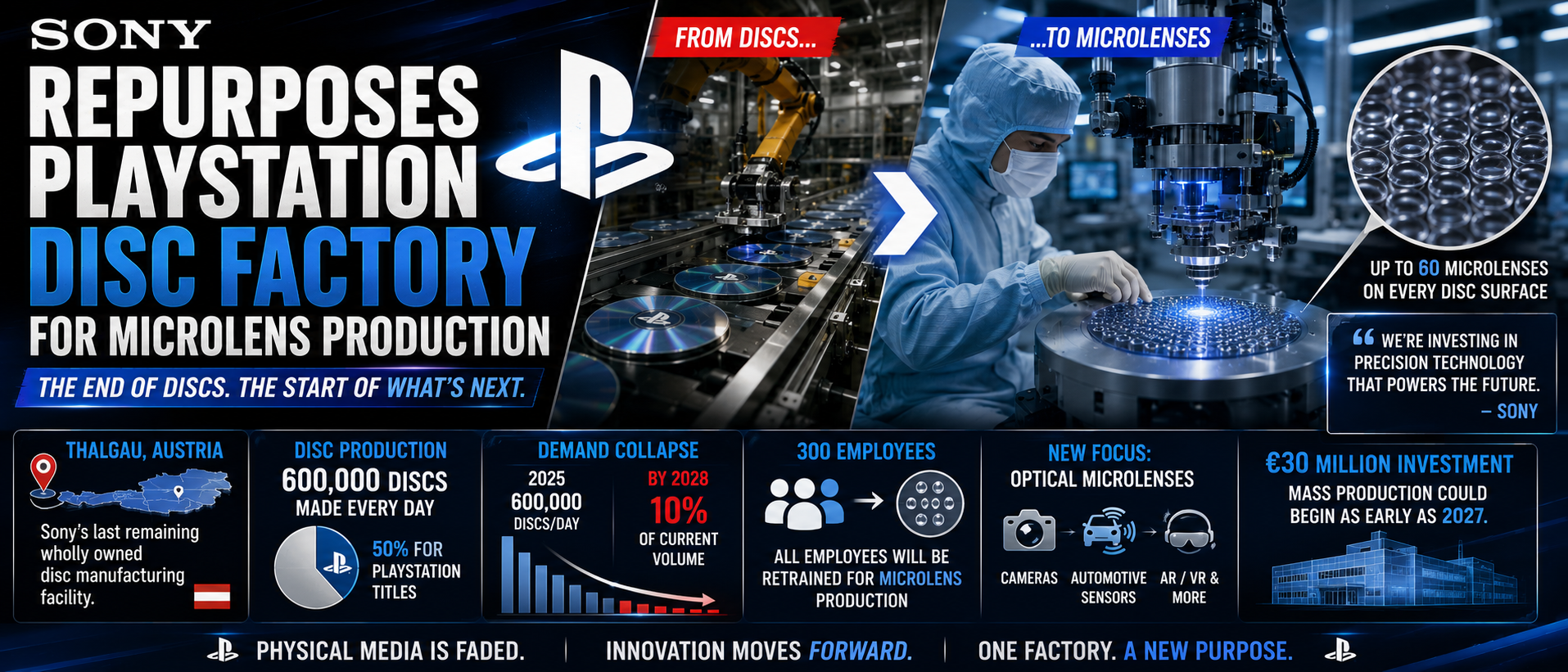
Thalgau is not simply one of Sony's disc plants. It is where the company's disc-making division is headquartered and appears to be its only remaining wholly owned facility dedicated to disc manufacturing. Currently, the plant produces 600,000 discs every single day, with half of that output going toward PlayStation titles. By 2028, however, that volume is expected to fall to just 10 percent of its current level - a collapse in demand so severe that Sony has decided to retrain all 300 employees at the site to work in an entirely different field. Rather than making discs for games and other media, those workers will be producing optical microlenses, a precision technology with applications well beyond consumer entertainment.
A Transition That Has Been Building for Years
This shift did not come out of nowhere. Sony has been winding down its disc manufacturing footprint for well over a decade. The company once operated disc plants in the United States, originally in Terre Haute, Indiana and later in New Jersey. The New Jersey facility closed in 2011, and in 2022, all remaining US manufacturing was consolidated into the Thalgau plant in Austria. The Indiana site has since reinvented itself, now marketing its services to the automotive industry for help with packaging and assembling components such as headlights.
Behind-the-scenes footage from December 2024 showed that the Thalgau plant was already experimenting with microlens work at that point, indicating the pivot had begun quietly before any public announcement. The connection between discs and microlenses is not as unusual as it might seem. The same disc format is actually used as part of the microlens manufacturing process, with up to 60 micro-optics fitting onto a single disc surface. In that sense, some of the existing equipment and expertise is being repurposed rather than scrapped entirely.
What Comes Next for the Plant and Physical Media
Sony has now committed €30 million to the microlens operation at Thalgau, and mass production could potentially begin as early as next year. The investment signals a genuine long-term commitment to the new direction rather than a stopgap measure while disc orders continue to dwindle. For the 300 employees at the site, the retraining programme represents a significant professional shift, moving from one of the most familiar manufacturing processes in consumer technology to a far more specialised and precision-driven field.
For gaming more broadly, the numbers tell a clear story. A facility once producing 300,000 PlayStation discs per day is on course to produce a fraction of that within two years. While physical media will not disappear entirely overnight, Sony's factory transition makes it plain that the company has already made its decision about where things are heading and is restructuring its operations accordingly. The disc that defined how people bought and owned games for decades is quietly being phased out, one factory at a time.