By Jacob Miller | Jul 10, 2026
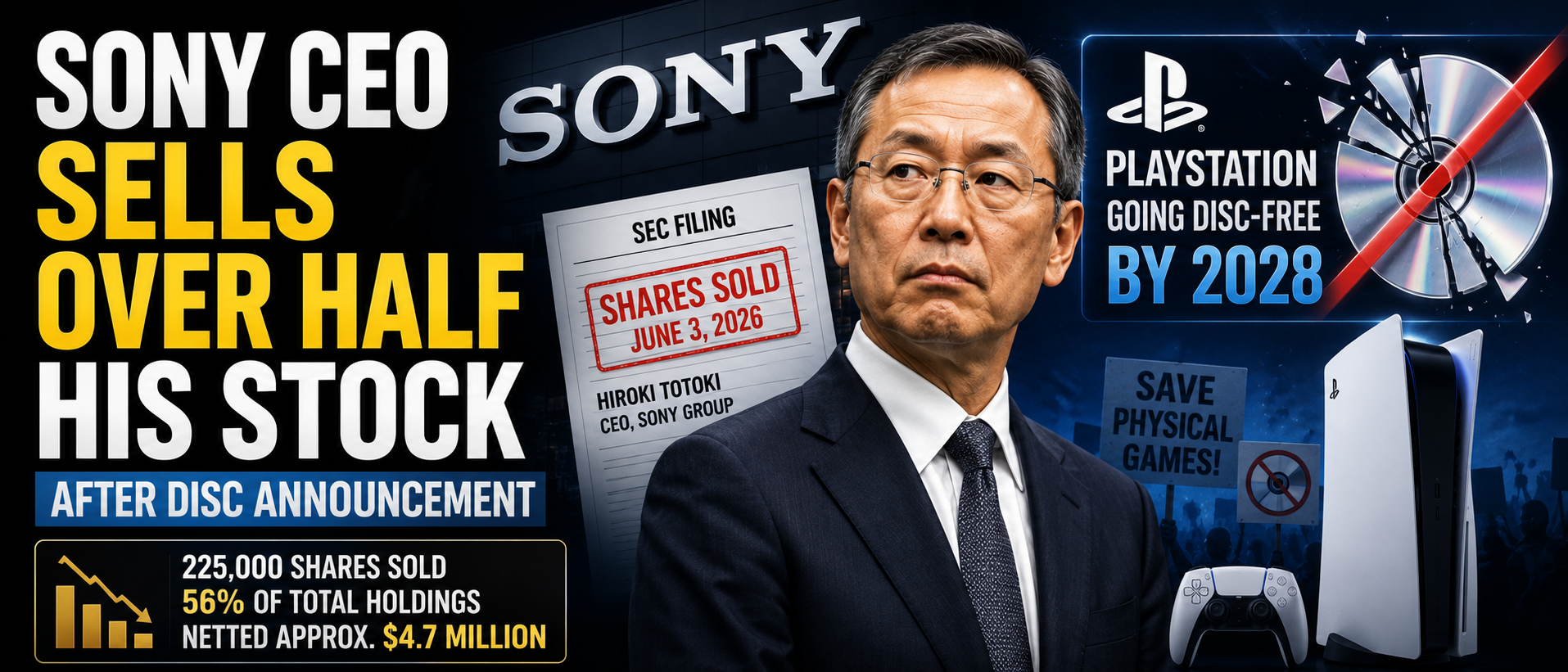
Whether the stock sales carry any deeper meaning is open to interpretation. Sony's share price has actually risen since the disc announcement rather than fallen, trading at $21.15 as of July 8 marginally above the price at which Totoki sold. That makes it difficult to argue the CEO was simply offloading ahead of an anticipated market drop. Still, the optics of a major stock sale happening in such close proximity to a decision that has generated significant public backlash have not been lost on observers within the gaming community.
Fan Backlash and Industry Reaction
The announcement that PlayStation would go entirely digital by 2028 landed hard with a vocal segment of the gaming community. Physical media enthusiasts immediately pushed back, with some cancelling their PS Plus subscriptions as a form of protest and urging Sony to reconsider. A petition calling on the company to reverse its decision has gathered over 237,000 signatures as of July 8 and continues to attract more. On social media, frustrated fans have taken to flooding PlayStation's posts with demands for the disc format to be preserved, while the company has remained silent in response.
Developers have also weighed in. High-profile voices in the industry, including those behind major releases, have spoken out in support of physical media and expressed sympathy for fans who prefer owning a tangible copy of the games they buy. Even the team behind Lords of the Fallen 2 acknowledged that profit margins on physical releases are tight, while still committing to a physical version out of respect for their audience. It is a sentiment that stands in some tension with the broader industry direction Sony appears to be setting.
What Industry Analysts Say and What Comes Next
Despite the noise, analysts are largely sceptical that the backlash will change anything. The financial logic behind Sony's decision is straightforward enough: physical game sales carry far smaller profit margins than digital ones, and by 2028 the company stands to collect 100 percent of the revenue on its exclusive titles without the costs associated with manufacturing, distribution, and retail. A few thousand cancelled PS Plus subscriptions, while symbolically meaningful, are unlikely to move the needle in any material financial sense.
Sony's business outlook for the rest of the year also remains strong on paper. Marvel's Wolverine is set to arrive in September, followed by the launch of Grand Theft Auto 6 in November two of the most anticipated releases in recent gaming history, both of which are expected to drive significant PS5 hardware sales. The company appears to be banking on the idea that when the games are good enough, the debate over physical versus digital fades into the background. Whether that calculation holds as 2028 draws closer, and as the gaming public becomes more accustomed to the idea of a disc-free PlayStation future, remains one of the more interesting stories in the industry to watch.