By Jacob Miller | Jul 30, 2026
Twitch has grown well beyond its origins as a gaming-focused streaming service. Today it hosts content across categories ranging from sports and music to lifestyle and personal vlogs, with many creators sharing significant portions of their daily lives with audiences. That expansion has brought the platform within reach of younger viewers in a much wider sense, making parental guidance tools more relevant than ever for families navigating what their children are watching and doing on the service.
What the New Parental Controls Actually Allow
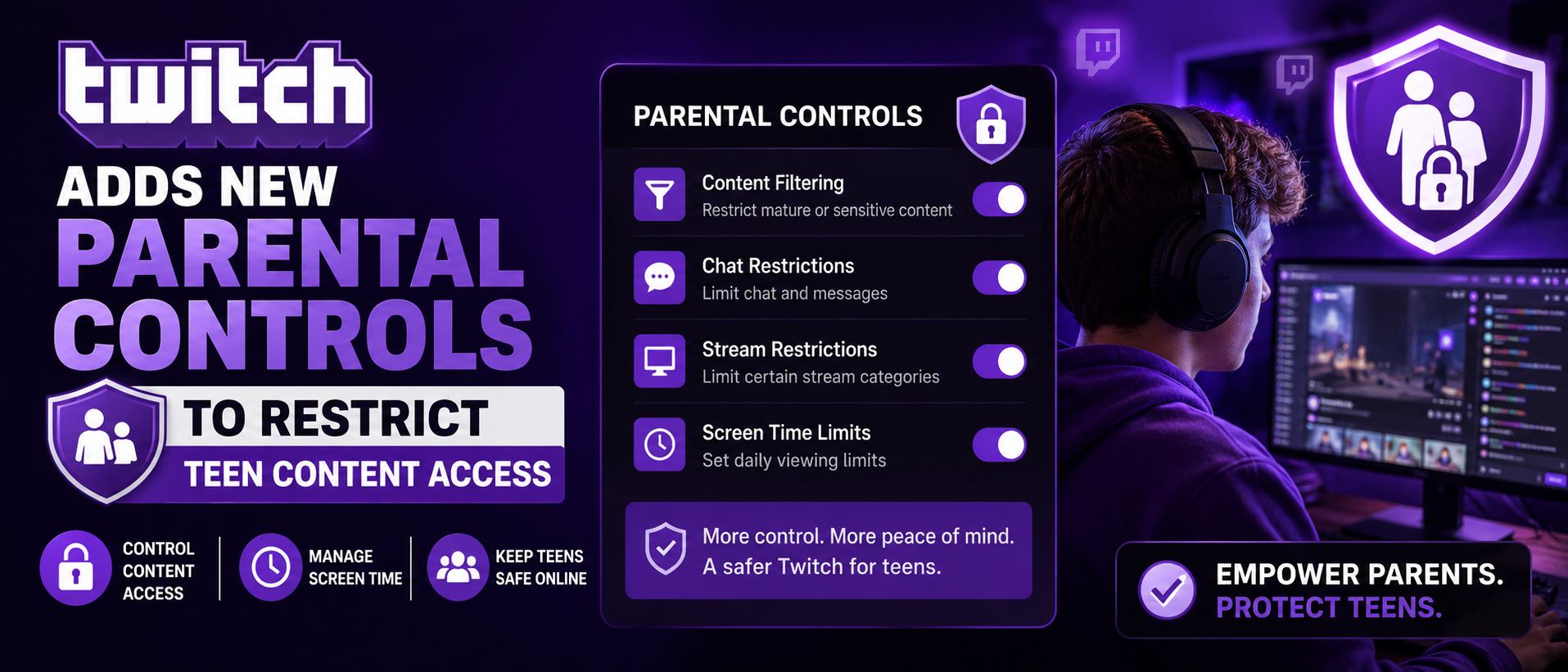
The new features give parents several specific levers to manage how their teenagers engage with Twitch. Parents will be able to restrict their child's access to content that carries certain Content Classification Labels, essentially filtering out material that has been flagged for mature or sensitive themes. Beyond content viewing, parents can also disable the ability for their child to send or receive direct messages on the platform entirely, removing a channel of communication that has raised concerns among child safety advocates across multiple online platforms.
Two further controls add meaningful layers of restriction. Parents can block their child from livestreaming on Twitch altogether, preventing them from broadcasting to an audience. Daily time limits can also be set to cap how long a teenager spends on the platform each day. These tools work in combination, giving parents a flexible toolkit rather than a one-size-fits-all setting. The controls are optional at launch rather than mandatory, and there is no limit on how frequently parents can adjust the settings for their child's account. Parents will need to create their own Twitch account to use the features, and the connection between parent and child accounts will be automatically removed when the child turns 18.
Twitch's Broader Push for Safer and Fairer Platform Standards
The parental control rollout is part of a wider year of changes at Twitch. Earlier in 2026, the platform significantly updated its moderation approach, drawing a clearer distinction between banning and suspending users based on whether their violation was chat-related or stream-related, with more severe punishments reserved for the most serious infractions. In May, Twitch also cracked down on viewbotting, which involves using artificial means to inflate a streamer's viewer count. Streamers found to have engaged in that practice now face caps on their concurrent viewer counts as part of the updated enforcement policy.
The platform has not been without controversy despite these efforts. Advertising practices have frequently generated friction between Twitch and its user base, including a recent dispute over the length of pre-roll and mid-roll ads. High-profile creators have also generated their share of headlines for various reasons throughout the year. Even so, Twitch remains one of the dominant forces in the global streaming industry, and the introduction of meaningful parental oversight tools suggests the company is taking its responsibilities toward younger users more seriously than it has in the past.